
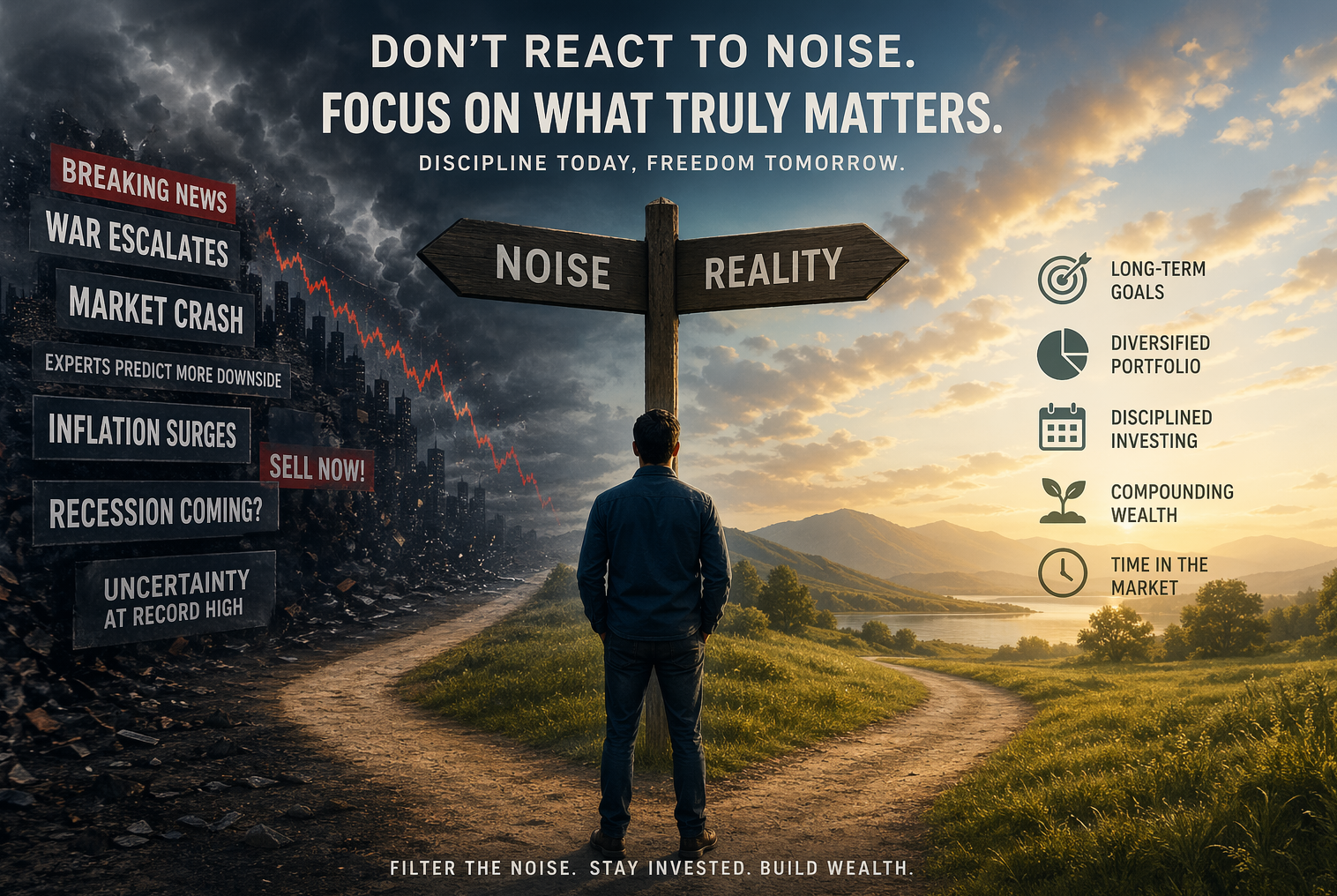
When global tensions rise – wars, geopolitical conflicts, economic sanctions – the financial markets react almost instantly. Red tickers flash across screens, breaking news alerts dominate headlines, and investors feel an overwhelming urge to do something.
But here’s the uncomfortable truth:
Most of what drives short-term market panic is noise, not reality.
Smart investors don’t react to noise. They learn to filter it.
What Is “Market Noise”?
Market noise refers to short-term information that creates emotional reactions but has little long-term impact on asset values.
In times of crisis, noise becomes louder:
- 24/7 news cycles amplifying fear
- Social media speculation and misinformation
- Experts making extreme predictions
- Sudden market swings driven by sentiment, not fundamentals
This noise creates a false sense of urgency – making inaction feel like a mistake.
Why Investors React to Noise
The challenge isn’t lack of information – it’s how our brains process uncertainty.
During crises, a few psychological biases take over:
1. Loss Aversion
We fear losses more than we value gains. Even a small drop feels like the beginning of something worse.
2. Recency Bias
We assume what’s happening now will continue. A falling market today feels like it will keep falling tomorrow.
3. Herd Mentality
When everyone around us is reacting, staying calm feels uncomfortable – even irresponsible.
These biases push investors toward impulsive decisions:
- Selling at the wrong time
- Pausing investments
- Constantly reshuffling portfolios
History Tells a Different Story
Markets have faced wars, crises, and global disruptions before. The pattern is surprisingly consistent:
- Initial Shock: Markets fall sharply due to uncertainty
- Information Phase: Clarity begins to emerge
- Stabilization: Investors adjust expectations
- Recovery: Markets move forward—often sooner than expected
The key insight:
Markets react faster than reality unfolds – and they recover before headlines improve.
Noise vs Reality: How to Tell the Difference
Not every event requires action. The ability to distinguish between noise and reality is what separates reactive investors from disciplined ones.
Here’s a simple framework:
1. Ask: Does This Impact Long-Term Fundamentals?
- Will this event affect corporate earnings over the next 3–5 years?
- Or is it a short-term disruption?
If the answer is unclear, it’s likely noise.
2. Check the Source of Information
- Is it data-driven or opinion-driven?
- Is it a headline designed to attract attention?
High emotional intensity often signals low informational value.
3. Look Beyond the Immediate Reaction
Markets often overreact first and rationalize later.
Instead of asking:
“What is the market doing today?”
Ask:
“What will this mean over the next few years?”
4. Revisit Your Original Investment Plan
Your portfolio was (or should have been) built with uncertainty in mind.
If your goals, time horizon, and risk tolerance haven’t changed,
your strategy shouldn’t either.
The Cost of Reacting to Noise
Reacting to every crisis doesn’t just create stress – it destroys returns.
Common mistakes include:
- Selling during panic → locking in losses
- Waiting for clarity → missing recovery
- Frequent changes → reducing compounding benefits
In many cases, the biggest damage isn’t market volatility – it’s investor behavior.
What Smart Investors Do Differently
Disciplined investors follow a few simple principles:
They Accept Uncertainty
Uncertainty isn’t an exception – it’s the norm in markets.
They Stay Consistent
They continue SIPs and long-term investments, regardless of headlines.
They Focus on Process, Not Predictions
They don’t try to guess the next move – they follow a structured plan.
They Zoom Out
Short-term volatility becomes insignificant when viewed over long time horizons.
A Practical Approach for Today’s Environment
If current events are making you uneasy, here’s a grounded way to respond:
- Pause before making decisions
- Avoid checking your portfolio too frequently
- Limit exposure to sensational news cycles
- Stick to your asset allocation
- Continue systematic investments if aligned with your plan
Sometimes, the best action is no action.
Final Thought
In times of crisis, the difference between successful and unsuccessful investors isn’t access to information – it’s the ability to filter it.
Noise will always be there.
Headlines will always create urgency.
But wealth is built by those who can stay calm when others cannot.
Stay focused. Stay disciplined. And most importantly – don’t let noise dictate your decisions.
Leave a Reply